An industrial unit considering biomass fuel is not simply choosing an alternative material to burn. It is making a decision that can affect the entire thermal-energy system: fuel storage, feeding equipment, combustion stability, heat-transfer surfaces, ash removal, emissions, maintenance schedules and the cost of producing useful heat.
This distinction is particularly important for industrial units operating around Rudrapur and the Pantnagar Integrated Industrial Estate in Udham Singh Nagar, Uttarakhand. The region has an established manufacturing base, with industrial activity connected to engineering, food processing, consumer goods and other production sectors. Rudrapur’s municipal profile identifies the development of the Pantnagar SIDCUL industrial estate as a major part of the city’s industrial growth.
However, the existence of an industrial cluster does not establish that every factory has a biomass-compatible boiler. Some facilities require steam, others use thermic-fluid heating or hot-air systems, and some depend primarily on electricity or direct-fired process equipment. Their operating temperatures, load patterns and fuel-handling arrangements are different.
A biomass fuel that performs adequately in one installation may create feeding difficulties, excessive ash deposits or unstable combustion in another. Even two boilers with similar rated capacities may respond differently because of differences in furnace geometry, grate design, air distribution, heat-transfer surfaces and pollution-control equipment.
The decision must therefore begin with the thermal requirement of the process, not with a fuel quotation.
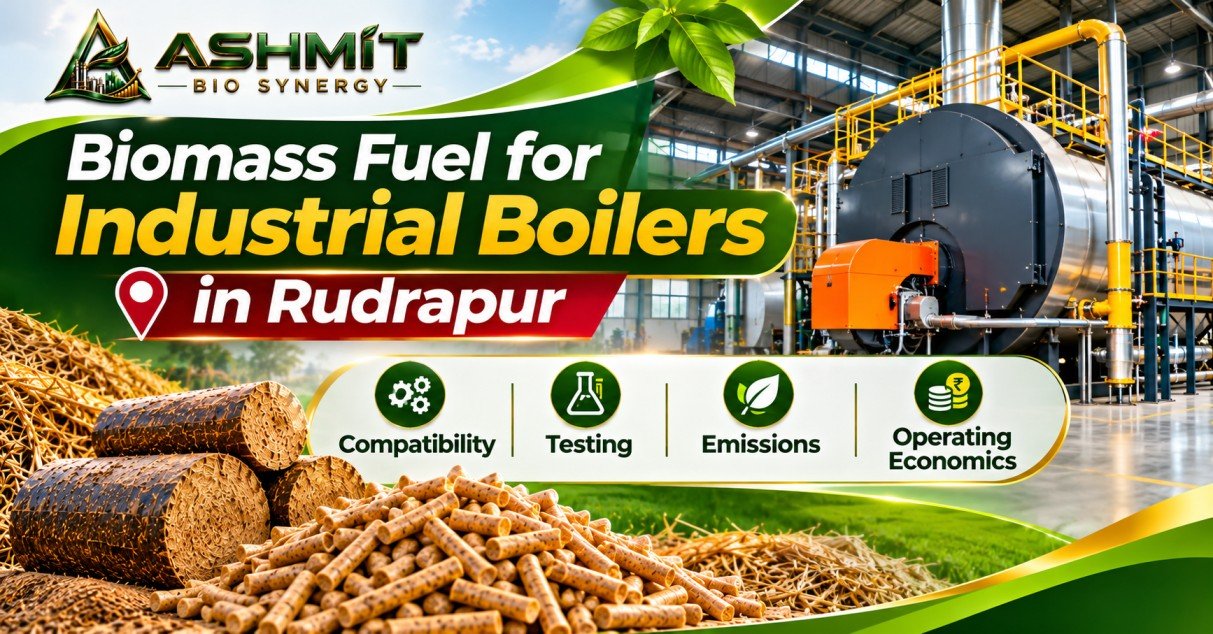
This article examines the engineering, fuel-quality, regulatory and economic considerations involved in evaluating biomass fuel for industrial boilers and thermal systems around Rudrapur. It also explains how an industrial user can move from an initial technical assessment to a controlled fuel trial without confusing theoretical fuel savings with demonstrated operating performance.
1. Why Industrial Boiler Fuel Selection Matters for Rudrapur’s Manufacturing Sector
Rudrapur is an important industrial centre in Udham Singh Nagar. Its development is closely connected with the Pantnagar Integrated Industrial Estate under SIDCUL, while the surrounding district also has manufacturing and agricultural-processing activity.
This industrial setting makes thermal-energy efficiency an important subject for individual manufacturing units. Depending on the process, a factory may require steam for heating or processing, hot air for drying, or thermal oil for maintaining controlled process temperatures.
These requirements cannot be treated as interchangeable.
A food-processing facility may depend on steam for cooking, cleaning or other thermal operations. A textile or chemical-processing unit may use steam or thermic fluid for temperature control. A manufacturing facility may require hot air for drying or curing. The fuel system must match the actual process requirement rather than the general category of industry.
The difference between energy consumption and useful process heat
A factory’s electricity bill, total energy consumption or installed boiler capacity does not independently reveal how much biomass it can use.
For a meaningful assessment, the following information is required:
- Actual steam generation or thermal output.
- Operating pressure and temperature.
- Feedwater temperature and condensate-return conditions.
- Daily and seasonal operating hours.
- Normal, peak and minimum process loads.
- Existing fuel consumption.
- Boiler or heater efficiency.
- Fuel storage and feeding capacity.
- Applicable pollution-control and consent conditions.
An industrial boiler rated at a particular steam capacity may not operate continuously at that rated output. A facility running at partial load for much of the day has a different fuel requirement from one operating continuously near its design capacity.
The distinction also matters commercially. A fuel supplier may quote a price per metric tonne, but the factory ultimately needs reliable heat at an acceptable cost.
The relevant question is therefore not simply whether biomass is cheaper per tonne. It is whether a particular biomass fuel can deliver the required process heat reliably, safely and within the plant’s technical and regulatory limits.
2. Begin with the Thermal Requirement: How Much Useful Heat Does the Plant Need?
Before evaluating a biomass fuel, the factory must establish its existing thermal-energy requirement.
For a steam boiler, useful heat depends on the mass of steam generated and the difference between the steam enthalpy and feedwater enthalpy. The enthalpy values must correspond to the actual operating pressure, temperature and feedwater condition.
The basic relationship is:
[
Q_{\text{useful}} =
\frac{\dot m_s(h_s-h_{fw})}{3600}
]
Where:
- (Q_{\text{useful}}) = useful steam duty in kW
- (\dot m_s) = steam production in kg/hour
- (h_s) = steam enthalpy in kJ/kg
- (h_{fw}) = feedwater enthalpy in kJ/kg
- 3600 = conversion factor from kJ/hour to kW
This calculation provides the useful heat transferred to the steam under the stated boundary. It does not directly give the quantity of biomass required.
An illustrative steam-duty calculation
Consider a hypothetical industrial boiler with the following conditions:
- Steam production: 1,000 kg/hour
- Enthalpy difference between steam and feedwater: 2,400 kJ/kg
The useful heat requirement is:
[
Q =
\frac{1,000 \times 2,400}{3,600}
]
[
Q = 666.7 \text{ kW}
]
The value of 2,400 kJ/kg is an illustrative assumption. A real plant must obtain the enthalpy difference from steam-table data corresponding to its actual steam and feedwater conditions.
The same principle applies to other thermal systems, but their useful-output equations are different.
Steam boilers, thermic-fluid heaters and hot-air generators
For a thermic-fluid heater, useful heat transfer is related to the mass flow of thermic fluid, its specific heat capacity and the temperature difference between the inlet and outlet.
[
Q = \dot m \times C_p \times \Delta T
]
For a hot-air generator, the useful thermal output depends on the air mass flow, specific heat and temperature rise:
[
Q = \dot m_{\text{air}} \times C_p \times \Delta T
]
The appropriate units and conversion factors must be applied consistently.
These systems also have different combustion-chamber, heat-transfer and control requirements. A biomass arrangement suitable for a steam boiler cannot automatically be transferred to a thermic-fluid heater or hot-air generator.
The Bureau of Energy Efficiency’s Energy Conservation Guidelines for the MSME Sector describe direct and indirect methods for assessing boiler efficiency. They also identify operating parameters such as steam generation, pressure, feedwater temperature, fuel consumption, flue-gas conditions and air ratio as important monitoring variables.
The practical lesson is straightforward: establish the actual heat duty and baseline operating performance before comparing alternative fuels.
3. Three Different Ways to Introduce Biomass into an Industrial Energy System
The expression “switching to biomass” can describe several technically different arrangements. These should be separated before a factory considers equipment modifications or procurement.
Route A: A dedicated biomass-fired boiler
A dedicated biomass boiler is designed or selected around a specified biomass fuel and its combustion characteristics.
Its combustion chamber, fuel-feeding arrangement, grate or bed, air-distribution system, ash removal and flue-gas treatment are selected as part of an integrated design.
The advantage of this approach is that the system can be engineered for the intended fuel. Its limitation is that it may require substantial capital investment, space, installation work and changes to existing utility infrastructure.
A new biomass boiler should be evaluated against the plant’s required steam conditions, process load, operating schedule and fuel-supply arrangements.
Route B: Converting or modifying an existing boiler
An existing coal- or other solid-fuel-fired boiler may be considered for biomass use, but conversion is not simply a matter of replacing one fuel with another.
The existing furnace and feeding system may not accommodate the new fuel’s dimensions, density, moisture or combustion behaviour.
A conversion assessment may identify requirements involving:
- Fuel receiving and storage.
- Crushing, screening or size preparation.
- Conveyor and feeding arrangements.
- Grate or combustion-bed modifications.
- Primary and secondary air distribution.
- Forced-draft and induced-draft fan capacity.
- Furnace temperature and residence time.
- Bottom-ash and fly-ash removal.
- Flue-gas treatment.
- Instrumentation and combustion controls.
The extent of modification depends on the original design and the proposed biomass.
No general percentage of conversion cost or guaranteed efficiency improvement should be assumed without an engineering assessment.
Route C: Co-firing or blending biomass with an existing fuel
Co-firing involves using biomass together with another fuel, rather than relying entirely on biomass.
It can provide a staged route for evaluating fuel substitution, but the feasibility depends on the combustion technology and the properties of both fuels.
Blending is not automatically safe simply because the two materials can be physically mixed. Their particle sizes, moisture, bulk density, ash chemistry and combustion behaviour may differ.
The Ministry of Power’s SAMARTH Mission published a revised Standard Operating Procedure for biomass pellet co-firing in pulverised-fuel coal-fired thermal power plants on 23 December 2025.
That document addresses pellet handling, storage, blending, combustion, operational issues and safety. Its scope is specifically pulverised-fuel coal-fired power stations. It should not be treated as a universal conversion instruction for every industrial boiler.
The distinction matters for industrial units: a power-station co-firing procedure is useful technical context, but the final arrangement for an individual factory must be designed around that factory’s own equipment.
4. Boiler Compatibility: What Must Be Checked Before a Fuel Change?
Boiler compatibility is a system-level question. Fuel quality is only one part of the answer.
A plant can receive a biomass fuel with a satisfactory laboratory report and still experience poor performance if the fuel-feeding equipment, combustion chamber or ash-handling arrangement is unsuitable.
A technical audit should examine the following areas.
Boiler design and combustion technology
The first step is to identify the existing combustion arrangement.
Common solid-fuel systems include fixed-grate, travelling-grate, chain-grate, reciprocating-grate and fluidised-bed arrangements. Pulverised-fuel systems operate differently and have their own milling, feeding and combustion requirements.
Each system responds differently to fuel size, moisture, density and ash behaviour.
For example, a fuel that moves reliably through one feeding arrangement may bridge, segregate or feed unevenly through another. A system designed for fine pulverised material cannot be assumed to accept large briquettes without suitable preparation and engineering changes.
Fuel-receiving and feeding equipment
The fuel must move from the delivery vehicle to the combustion zone at a controlled rate.
The audit should cover:
- Unloading and material-receiving arrangements.
- Storage bins and hoppers.
- Conveyor capacity.
- Fuel metering and dosing.
- Crusher or screening requirements.
- Feeding-system blockage risks.
- Protection against foreign materials.
- Emergency isolation arrangements.
The bulk density of the fuel affects how much storage volume and conveyor capacity may be required for a given mass flow.
Furnace and air-distribution system
Biomass combustion requires the correct combination of fuel preparation, temperature, residence time and combustion air.
The system must be checked for primary-air supply, secondary-air distribution, draft conditions, fan capacity and the ability to maintain stable combustion across normal operating loads.
A fuel change can alter the quantity of fuel required per hour, the air requirement and the volume of combustion products.
A fan or duct system sized around the original fuel should therefore be assessed rather than assumed adequate.
Heat-transfer surfaces and ash removal
The audit must also examine the condition and arrangement of furnace walls, boiler tubes, superheaters where installed, economisers and other heat-transfer surfaces.
Ash deposits can reduce heat transfer and increase cleaning requirements. A fuel with a higher ash burden may also require changes to bottom-ash discharge and fly-ash collection.
Controls, instrumentation and safety interlocks
A biomass conversion should not bypass existing protective systems.
The engineering review should consider fuel-feed interlocks, furnace pressure, temperature monitoring, flame supervision where applicable, draft control, emergency shutdown procedures and safe operation during startup and shutdown.
The boiler manufacturer or a competent boiler-system engineer should review any proposed structural or combustion-system modifications. Applicable statutory inspection and approval requirements must also be confirmed before work begins.
A compatibility assessment should result in a written engineering scope, not simply a verbal statement that a boiler can burn biomass.
5. Biomass Fuel Quality: Which Laboratory Parameters Actually Matter?
The term biomass fuel covers a wide range of materials. Pellets, briquettes and other densified agricultural residues may differ significantly in physical and chemical characteristics.
A useful fuel specification must describe the material that will actually arrive at the plant.
The Bureau of Indian Standards has published separate product standards for agricultural and herbaceous biomass pellets and briquettes:
- IS 18724:2024 — Pellets from agro and herbaceous residues.
- IS 18725:2024 — Briquettes from agro and herbaceous residues.
These standards cover fuel properties and reporting requirements, including origin, physical dimensions, moisture, ash, calorific value and other relevant characteristics. They provide a technical basis for defining and communicating fuel quality; the buyer must still specify the requirements appropriate to its own equipment.
Moisture content
Moisture is one of the most important parameters in biomass fuel assessment.
A higher moisture level means part of the fuel’s energy is used to heat and evaporate water during combustion. It can reduce usable heat per kilogram, affect ignition and change combustion stability.
Moisture can also influence storage conditions and the risk of material deterioration.
A moisture result must state its reporting basis. For example, wet-basis moisture is calculated as:
[
M_{wb} =
\frac{\text{Mass of water}}{\text{Total as-received mass}}
\times 100
]
The distinction between wet basis and dry basis must be maintained throughout the calculation and the purchase agreement.
Gross and net calorific value
Gross calorific value (GCV), also known as higher heating value, and net calorific value (NCV or LHV), also known as lower heating value, are not interchangeable.
The difference relates principally to the treatment of the heat associated with water vapour in the combustion products.
A buyer should confirm:
- Whether the report gives GCV or NCV.
- Whether the value is on a dry basis or as-received basis.
- The test method used.
- Whether the sample represents the delivered lot.
- Whether the reported value is appropriate for the boiler’s efficiency calculation.
A fuel specification stating only a calorific value without its basis is incomplete for reliable energy comparison.
Ash content
Ash is the inorganic residue remaining after combustion under the specified test conditions.
A higher ash content can increase the mass of solid residue that must be removed, transported, handled and disposed of or otherwise managed.
However, ash percentage alone does not describe ash behaviour. Its chemical composition and melting characteristics also matter.
Volatile matter and fixed carbon
Proximate analysis commonly includes moisture, volatile matter, ash and fixed carbon.
Volatile matter influences ignition and the release of combustible gases during heating. Fixed carbon contributes to the solid-char combustion stage.
These parameters help describe combustion behaviour, but they must be interpreted with the actual boiler design and operating conditions.
Bulk density, dimensions, durability and fines
Bulk density influences storage volume and material movement. Pellet or briquette dimensions affect feeding and the combustion system’s ability to handle the material.
Mechanical durability indicates how well densified fuel resists breakage during handling. Fines are the smaller particles created during manufacturing, loading, transportation and unloading.
Excessive fines can create dust, alter feeding behaviour and cause material losses.
Chemical composition and contaminants
For certain agricultural fuels, the following parameters may also be relevant:
- Sulphur and chlorine.
- Nitrogen.
- Potassium, sodium, silicon and calcium.
- Other major and minor inorganic elements.
- Foreign matter, soil and contamination.
The appropriate test panel depends on the fuel source and the boiler’s design.
A material should not be accepted solely because its calorific value looks attractive. Its complete quality profile must be evaluated against the intended application.
6. Ash Chemistry, Slagging, Fouling and Corrosion: The Risks Behind a High GCV
One of the most important technical issues in agricultural biomass combustion is the behaviour of ash at elevated temperatures.
Two fuels with similar calorific values can behave very differently inside a boiler because their ash compositions are not necessarily similar.
The BIS foreword to IS 18724:2024 specifically highlights the higher concentration of ash-forming elements in many agro and herbaceous residues and the potential for lower ash-melting temperatures compared with many woody biomass fuels.
It identifies potassium, silicon, calcium, chlorine and phosphorus as relevant to the chemistry associated with fouling, slagging and corrosion.
These are not merely laboratory concerns. They can affect heat-transfer performance, maintenance requirements and equipment availability.
What is slagging?
Slagging occurs when ash softens or melts and forms deposits in high-temperature combustion areas.
Depending on the ash composition and operating temperature, these deposits can become hard and difficult to remove.
A build-up can interfere with combustion, restrict the effective area of the furnace and increase cleaning requirements.
What is fouling?
Fouling is the accumulation of ash and other deposits on heat-transfer surfaces, particularly where combustion gases carry fine particles towards boiler tubes and other surfaces.
The deposits can act as an insulating layer, reducing heat transfer from the hot gases to the working fluid.
The boiler may then require more fuel to deliver the same useful heat, or cleaning and maintenance intervals may become shorter.
What is bed agglomeration?
In fluidised-bed systems, ash-related interactions can cause bed particles to stick together.
This can interfere with fluidisation and disturb the operation of the combustion bed.
The risk depends on fuel chemistry, bed material, temperature and operating conditions.
What is high-temperature corrosion?
Certain alkali compounds and chlorine-containing species can contribute to corrosive deposits on boiler and flue-gas-system surfaces.
The risk depends on the chemical composition of the fuel and ash, combustion conditions, material temperatures and the design of the affected equipment.
Why ash-fusion testing can be important
Where the fuel and boiler design justify it, an assessment may include ash-fusion behaviour.
The characteristic temperatures commonly examined include:
- Initial deformation temperature.
- Softening temperature.
- Hemispherical temperature.
- Flow temperature.
These values help describe how ash changes shape as temperature increases. They do not, on their own, provide a complete prediction of deposit formation.
A proper evaluation also considers ash chemistry, furnace temperature, residence time, air distribution and the location of heat-transfer surfaces.
This is why a fuel’s GCV cannot be used as the sole measure of boiler compatibility.
A controlled trial may reveal operational behaviour that a single laboratory parameter cannot predict.
7. Biomass Boiler Emissions and Environmental Compliance in Uttarakhand
Fuel selection and pollution-control compliance must be assessed together.
The fact that a fuel is biomass-based does not automatically exempt an industrial unit from air-pollution requirements. A plant must comply with applicable emission standards, consent conditions and other permissions relevant to its operations.
Uttarakhand Pollution Control Board’s approved-fuel order
The Uttarakhand Pollution Control Board issued an office order dated 17 July 2020 listing approved fuels for use in the state. The list includes agro-based biofuel.
The same order requires adequate air-pollution-control measures and refers to Environmental Clearance, Consent to Establish and Consent to Operate, as applicable, from the competent authority.
This should be read as a dated policy document, not as a blanket approval for every biomass product or every industrial installation.
An industrial unit must verify its current consent conditions, the fuel description permitted for its category, and whether a proposed fuel or equipment modification requires an amendment or additional approval.
The Uttarakhand Pollution Control Board’s online consent-management system provides the relevant route for checking consent-related requirements.
National particulate-matter standards for industrial boilers
The Ministry of Environment, Forest and Climate Change issued G.S.R. 373(E) on 16 May 2023, published in the Gazette on 17 May 2023.
The amendment came into force after two years from publication, making the revised standards effective from 17 May 2025.
For the industrial-boiler categories covered by the notification, the particulate-matter limits are differentiated by steam-generation capacity and fuel category.
| Industrial boiler capacity | Agro-based fuels / bagasse | Other fuels |
|---|---|---|
| Less than 2 TPH | 500 mg/Nm³ | 500 mg/Nm³ |
| 2 to less than 10 TPH | 250 mg/Nm³ | 150 mg/Nm³ |
| 10 TPH and above | 250 mg/Nm³ | 100 mg/Nm³ |
The notification also includes thermic-fluid heaters and hot-air generators on an equivalent-fuel-consumption basis.
These values are particulate-matter limits from the specified amendment. They should not be interpreted as a complete list of every environmental requirement applicable to a particular factory.
Oxygen normalisation matters
The Gazette requires measured particulate matter, sulphur dioxide and nitrogen oxide values to be normalised on a dry basis to 6% oxygen for solid fuels and 3% oxygen for liquid fuels when comparing with the specified standards.
For solid fuels, the relationship is:
[
C_{ref} =
C_{measured}
\times
\frac{21-6}{21-O_{2,measured}}
]
Where:
- (C_{ref}) = oxygen-normalised concentration.
- (C_{measured}) = measured concentration.
- (O_{2,measured}) = measured oxygen percentage in the flue gas.
This matters because the same measured pollutant concentration can appear different when excess air and oxygen levels differ.
A factory should therefore not compare an uncorrected stack-test result directly with a limit expressed at a specified reference oxygen level.
Stack height and pollution-control equipment
The same amendment specifies stack-height calculations and minimum heights for the relevant industrial boiler categories. The applicable calculation depends on the emission rates and the notification’s conditions.
Pollution-control equipment must be selected according to the actual fuel, boiler design, gas volume, temperature and expected particulate loading.
Depending on the installation, the assessment may consider cyclones or multicyclones, bag filters, electrostatic precipitators and other suitable control arrangements.
The presence of a pollution-control device does not prove compliance by itself. Its performance, operating condition, maintenance and the measured stack emissions are what matter.
Before a biomass conversion or regular fuel substitution, the plant should obtain written clarity from its environmental consultant and the relevant Pollution Control Board authority regarding its consent, emission-testing and equipment requirements.
8. Biomass Storage, Fuel Handling and Operational Safety
A fuel system does not begin at the furnace. It begins when the delivery vehicle arrives at the plant.
A biomass fuel may be suitable for combustion but still create operational problems if unloading, storage, movement and metering are not designed for its physical characteristics.
Moisture protection and storage design
Some non-torrefied biomass pellets are hygroscopic and can absorb moisture from the surrounding atmosphere.
The Ministry of Power’s SAMARTH co-firing SOP identifies moisture sensitivity and the need for appropriate storage and handling arrangements for pellets in its specific power-station context.
For an industrial facility, the appropriate storage solution depends on the material, climate exposure, delivery frequency, inventory size and feeding arrangement.
The assessment should cover:
- Covered storage where required by the fuel specification.
- Protection from rainwater and ground moisture.
- Adequate ventilation and drainage.
- Separation of different fuel lots.
- Safe access for unloading and handling equipment.
- Stock rotation and traceability.
- Protection against contamination.
A large stockpile is not automatically a reliable supply strategy. Poorly managed storage can change fuel quality and create avoidable handling risks.
Fire prevention and monitoring
Biomass storage and conveying systems must be assessed for fire hazards.
The risk-management plan should address ignition sources, hot surfaces, electrical equipment, dust accumulation, conveyor areas, storage arrangements and emergency access.
Depending on the material and site design, appropriate detection, firefighting provisions and isolation arrangements may be necessary.
The SAMARTH SOP for pulverised-fuel power stations includes specific provisions relating to firefighting, storage infrastructure, material handling and monitoring. Those provisions are a technical reference for understanding the hazards, not a substitute for a site-specific industrial safety design.
Weighing, unloading and inventory control
Accurate weighing is important because fuel consumption calculations are only as reliable as the mass data used.
The receiving process should establish:
- Vehicle gross and tare weights.
- Net delivered mass.
- Delivery identification and supplier lot number.
- Unloading date and time.
- Material type and declared feedstock.
- Sampling record.
- Accepted, rejected or conditionally accepted quantity.
For regular procurement, the plant should also track opening stock, receipts, consumption and closing stock.
This helps identify differences between purchased fuel, measured fuel consumption and actual process output.
Ash handling and disposal
Ash is a physical output of the combustion process and must be included in the plant’s material-handling plan.
The quantity and characteristics depend on fuel composition, moisture, combustion conditions and the amount of unburned material.
The unit should determine how bottom ash and fly ash will be collected, stored, transported and managed in accordance with applicable requirements.
No assumption should be made that every biomass ash is automatically suitable for agricultural application, construction use or unrestricted disposal.
Its quality and permitted destination must be verified.
9. Real Fuel-Consumption Mathematics: Comparing Cost per Useful Heat
A technically meaningful biomass comparison must connect fuel quality with useful heat output and boiler efficiency.
Comparing only the price per metric tonne can produce a misleading result. A fuel with a lower purchase price may require more kilograms per hour because it has a lower as-fired energy value or because the operating system achieves a different efficiency.
Step 1: Calculate useful heat requirement
For the illustrative 1,000 kg/hour steam requirement in Section 2:
[
Q_{\text{useful}} = 666.7 \text{ kW}
]
Step 2: Calculate biomass fuel consumption
When using an as-fired lower heating value, the fuel mass flow can be estimated as:
[
\dot m_f =
\frac{Q_{\text{useful}}}
{(LHV_{ar}/3.6)\times \eta}
]
Where:
- (\dot m_f) = fuel consumption in kg/hour.
- (LHV_{ar}) = as-received lower heating value in MJ/kg.
- (\eta) = boiler efficiency expressed on the same LHV basis.
- 3.6 = conversion factor from MJ/kg to kWh/kg.
The efficiency and heating-value basis must match. An LHV-based calculation must not be combined with an efficiency figure calculated on a GCV basis without conversion.
Step 3: Compare different fuel-quality and efficiency scenarios
The following scenarios use the same useful heat requirement of 666.7 kW.
All fuel properties and efficiencies below are illustrative assumptions, not Ashmit product specifications or verified values from Rudrapur factories.
| Scenario | As-fired LHV | Efficiency on LHV basis | Estimated fuel consumption |
|---|---|---|---|
| A | 12 MJ/kg | 75% | 266.7 kg/hour |
| B | 10 MJ/kg | 75% | 320.0 kg/hour |
| C | 12 MJ/kg | 70% | 285.7 kg/hour |
| D | 10 MJ/kg | 70% | 342.9 kg/hour |
The comparison shows two separate effects.
At the same efficiency, reducing the as-fired LHV from 12 MJ/kg to 10 MJ/kg increases the required fuel mass by 20%.
At the same LHV, reducing efficiency from 75% to 70% increases fuel consumption by approximately 7.1%.
When both factors change together, the estimated fuel requirement rises from 266.7 kg/hour to approximately 342.9 kg/hour.
That is an increase of approximately 28.6% for the same assumed useful heat output.
The calculation illustrates why the delivered fuel’s actual moisture and energy content, together with real boiler efficiency, matter more than a generic statement about kilograms of biomass per tonne of steam.
Step 4: Convert hourly fuel consumption into a daily requirement
If the illustrative boiler operates for 16 hours per day:
For Scenario A:
[
266.7 \times 16 =
4,267 \text{ kg/day}
]
Approximately 4.27 tonnes per operating day.
For Scenario D:
[
342.9 \times 16 =
5,486 \text{ kg/day}
]
Approximately 5.49 tonnes per operating day.
This difference affects storage capacity, delivery frequency, unloading arrangements and working capital.
Actual daily procurement should be based on the plant’s load profile, not simply its rated boiler capacity multiplied by 24 hours.
Step 5: Compare the cost of useful heat
The cost per unit of useful heat can be estimated as:
[
\text{Cost per useful GJ} =
\frac{\text{Delivered fuel price per kg}}
{LHV_{ar}\times\eta}
\times 1000
]
For illustration, assume:
Fuel A
- Delivered price: ₹8/kg
- As-fired LHV: 12 MJ/kg
- Efficiency: 75%
Useful heat per kilogram:
[
12 \times 0.75 = 9 \text{ MJ/kg}
]
Cost per useful GJ:
[
\frac{8}{9}\times1000 =
₹888.89/\text{GJ}
]
Fuel B
- Delivered price: ₹7/kg
- As-fired LHV: 10 MJ/kg
- Efficiency: 70%
Useful heat per kilogram:
[
10 \times 0.70 = 7 \text{ MJ/kg}
]
Cost per useful GJ:
[
\frac{7}{7}\times1000 =
₹1,000/\text{GJ}
]
Although Fuel B has the lower price per kilogram in this illustrative example, its cost per unit of useful heat is higher.
These prices are hypothetical and are not current market quotations, Ashmit prices or Rudrapur delivery rates.
Step 6: Estimate ash-handling quantity
Ash handling should also be included in the operating comparison.
Where laboratory ash content is reported on a dry basis:
[
\dot m_{\text{ash}} =
\dot m_{\text{fuel,ar}}
\times(1-M_{wb})
\times A_{db}
]
Where:
- (\dot m_{\text{ash}}) = estimated ash generation in kg/hour.
- (\dot m_{\text{fuel,ar}}) = as-received fuel consumption in kg/hour.
- (M_{wb}) = wet-basis moisture fraction.
- (A_{db}) = dry-basis ash fraction.
For example, using an illustrative fuel consumption of 342.9 kg/hour, 12% wet-basis moisture and 15% dry-basis ash:
[
342.9\times0.88\times0.15
=45.26 \text{ kg/hour}
]
This is an illustrative mass-balance estimate. Actual collected bottom ash and fly ash may differ because of unburned carbon, dust losses, collection efficiency and operating conditions.
What the cost calculation does not include
The delivered useful-heat comparison is a screening tool, not a complete investment appraisal.
A full economic evaluation may also need to include:
- Boiler conversion or replacement cost.
- Fuel-receiving and storage infrastructure.
- Conveyors and feeding equipment.
- Additional labour and handling.
- Auxiliary electricity.
- Ash removal and management.
- Maintenance and cleaning frequency.
- Startup and standby fuel.
- Production interruptions and downtime.
- Financing and depreciation.
- Applicable taxes and commercial terms.
The most useful comparison is the total cost of producing the required process heat while maintaining acceptable production, safety and compliance performance.
10. How to Conduct a Controlled Biomass Fuel Trial Before Regular Procurement
A controlled trial connects laboratory results with actual boiler behaviour.
It allows the industrial user to evaluate whether a fuel that appears suitable on paper performs consistently in the intended combustion system.
The trial should be planned jointly by the plant’s engineering team, operations team, safety personnel and the relevant equipment specialists.
Establish a baseline using the existing fuel
Before introducing the proposed biomass, record the plant’s normal performance over a representative operating period.
The baseline should include:
- Production output.
- Steam generation or useful thermal output.
- Operating pressure and temperature.
- Feedwater conditions.
- Existing fuel consumption.
- Fuel quality and heating-value basis.
- Flue-gas temperature and oxygen.
- Carbon monoxide where monitored.
- Ash generation and unburned carbon.
- Cleaning and maintenance frequency.
The comparison period should reflect normal production conditions and account for significant changes in load or product mix.
Agree on a fuel specification before delivery
The buyer and supplier should agree on the material’s identity and acceptable properties before the trial.
The specification should identify the feedstock, dimensions, moisture basis, calorific-value basis, ash content, fines and any additional chemical parameters relevant to the boiler.
The agreement should also define how a delivery will be sampled, tested and accepted.
Use representative sampling
A laboratory report is meaningful only when the sample represents the lot being delivered.
BIS IS 19410:2026 establishes principles for solid-biofuel sampling. It addresses lot and sub-lot identification, increments, sampling equipment, locations and other factors that influence representativeness.
For a truck delivery or a larger stockpile, the sampling plan should be selected according to the material and the quantity being assessed. A sample taken only from an easily accessible surface may not represent the full load.
The parties should maintain:
- Sampling-plan reference.
- Delivery and lot identification.
- Date and sampling location.
- Sampler’s identity.
- Sampling method and equipment.
- Laboratory sample identification.
- Sealed or retained reference sample where agreed.
- Test results and acceptance decision.
IS 18640:2024 provides the sample-preparation framework, including sample division and particle-size reduction before laboratory analysis.
The objective is to make the result traceable and suitable for a commercial quality decision.
Monitor performance during the trial
The trial should examine more than whether the fuel burns.
The plant should evaluate:
- Stable fuel feeding.
- Ignition and combustion stability.
- Steam or thermal output.
- Fuel consumption at comparable production loads.
- Flue-gas oxygen and temperature.
- Carbon monoxide trends where measured.
- Ash quantity and composition.
- Slagging, fouling or clinker formation.
- Cleaning and maintenance requirements.
- Pollution-control performance.
- Operational interruptions.
BEE’s guidelines identify steam generation, pressure, fuel consumption, air ratio and flue-gas temperature as relevant monitoring parameters. For solid-fuel systems, additional attention to residual oxygen, carbon monoxide and unburned carbon can help evaluate combustion quality.
The trial should be stopped or adjusted if safety, emissions, equipment or product-quality conditions require intervention.
Define acceptance criteria before scaling up
The buyer should not decide whether a fuel is successful based on a single favourable operating shift.
The trial should have predefined acceptance criteria covering technical performance, quality consistency, emissions, handling, ash management and commercial cost.
The final decision should answer five questions:
- Can the fuel be fed and burned reliably in the intended equipment?
- Does it produce the required useful heat under normal operating conditions?
- Are ash behaviour, cleaning and maintenance requirements manageable?
- Can the installation meet its applicable environmental and consent conditions?
- Is the delivered cost per unit of useful heat commercially acceptable?
Only after these questions are answered should the plant consider regular procurement or a larger conversion programme.
What industrial buyers around Rudrapur should evaluate
For manufacturers around Rudrapur, Pantnagar, Sitarganj and nearby industrial locations, the correct biomass decision will depend on the individual plant’s process requirements and installed thermal system.
A useful technical discussion should begin with the boiler or heater type, rated and actual operating capacity, present fuel, daily consumption, required heat output and the proposed biomass specification.
The supplier should be able to identify the offered fuel, explain its declared quality parameters and clarify the commercial supply terms. The buyer should independently verify that those parameters are suitable for the intended equipment.
Businesses evaluating biomass fuel supply options for industrial operations in the region can also review Ashmit Bio Synergy’s biomass fuel manufacturer and supplier services in Rudrapur.
The service page provides the relevant commercial destination for buyers exploring supply options. The technical suitability of any proposed fuel must still be established against the buyer’s equipment, verified fuel data and operating requirements.
Conclusion: A Biomass Conversion Decision Must Be Proven Through Engineering and Operating Data
Biomass fuel can be a relevant option for selected industrial thermal applications, but its suitability cannot be established by fuel price, calorific value or boiler capacity alone.
A reliable assessment begins with the plant’s useful heat requirement. It then examines the combustion route, boiler compatibility, fuel specification, ash chemistry, pollution-control system, storage arrangement and operating economics.
The calculation of fuel consumption must use a consistent heating-value and efficiency basis. Laboratory results must represent the delivered material. Emissions must be assessed against the applicable standards and the plant’s consent conditions. Any conversion or trial must be carried out with appropriate engineering review and operational safeguards.
For industrial users around Rudrapur, the most defensible approach is a measured one: establish the baseline, define the fuel specification, verify the sample, conduct a controlled trial and compare the resulting useful-heat cost with the existing system.
A biomass fuel should be selected because it performs reliably in the intended application—not because a general claim makes it appear suitable.
The value of an industrial biomass energy decision lies in the quality of the evidence behind it.